


.jpg) Instant noodles at a supermarket in South Africa. — VNS Photo Hồng Minh
Instant noodles at a supermarket in South Africa. — VNS Photo Hồng MinhBy Hồng Minh
I used to think instant noodles would taste almost the same wherever I went. This perception changed utterly when I moved to South Africa temporarily last year. The time was long enough for me to taste most of the local food, along with the instant noodles of local brands, to realise that I have started craving for Vietnamese-flavoured noodles.
I remember well that prior to my departure in April last year, at the peak of the COVID-19 pandemic, with South Africa one of hot spots with new SARS-CoV-2 variants, I prepared a box of mỳ chua cay (instant noodles with shrimp, spicy and acidic flavours) from one of the popular brands in Việt Nam.
At that time, I simply thought of it as a just-in-case situation if I must undergo a week-long quarantine upon arrival in a foreign country. My spouse jokingly called me “crazy” when seeing the box. He had the same thought as I did, that “instant noodles are alike everywhere”. We ended up leaving the box in Việt Nam, which we both regretted later.
 The instant noodles with shrimp, spicy and acidic flavours. — Photo courtesy of Acecook
It turns out instant noodles, indeed, are everywhere, but not the same in flavour. The local flavours in South Africa are far different from tôm chua cay, lẩu nấm (mushroom hot pot), gà lá chanh (chicken and lime leaves) or many other flavours imitating traditional food dishes. In a faraway country, especially in the pandemic era, it has been a long time since I have been able to get Vietnamese noodles which are normally very easy to pick up in Việt Nam. I have to wait for people coming to South Africa to bring some of the flavours I miss.
And I am not alone. Many of my friends who have been living away from Việt Nam, especially places where Vietnamese products have not been imported to, echoed me that they missed the flavours of instant noodles in Việt Nam. They have named some - Hảo Hảo, Cung Đình, Miliket, Omachi - as their favourite brands.
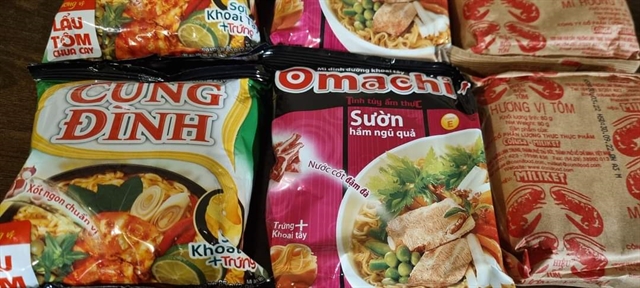 Various types of Vietnamese instant noodles with different flavors. — VNS Photo Hồng Minh
When Momofuku Ando invented instant noodles in 1958, did he expect the precooked and dried block of noodles with seasoning would quickly become a popular and loved dish worldwide with undeniable conveniences, namely they are fast to cook, can be preserved for a long time and are very suitable for storage? Even many Japanese people have the belief that their country’s greatest invention is instant noodles. In Việt Nam, the first packages of instant noodles were said to appear quite early, from the 1960s, in the South in the form of relief goods. The new-style dish that only requires boiling water to be cooked and consumed within a few minutes, quickly became a "hot trend" in the country at that time. Gradually, it has become one of the indispensable dishes in the lives of many generations of Vietnamese people.
In my childhood memories dating back to the early 1980s, instant noodles in Việt Nam were mostly packaged in a bunch in a big nylon bag together with the corresponding quantity of flavour packets. A higher version of instant noodles at that time was noodles packed separately in a paper pack. Unlike the nowadays, when instant noodles are sold in a wide range of selections in brands, flavours and packaging types that we can easily buy from markets and supermarket, instant noodles of my childhood were a high-class, precious and rare dish that I could only eat on special occasions, like when I was sick or when I was rewarded for high scores at school.
The mỳ ăn liền,literally “instant noodles”, was then widely called mỳ tôm (shrimp noodles) as the Vietnamese manufacturers started to introduce the shrimp flavour instead of the original chicken flavour of Japan. The mỳ tôm was even upgraded from hai tôm (two shrimps) to bốn tôm (four shrimps). In my naïve mind, I used to believe that the real quantity of shrimps was actually used to make the noodles I ate. Many manufacturers chose the imagine of red, fat and tasty shrimp to print on the package to attract customers. And so, generations of Vietnamese people call the dish mỳ tôm, no matter what flavour it is.
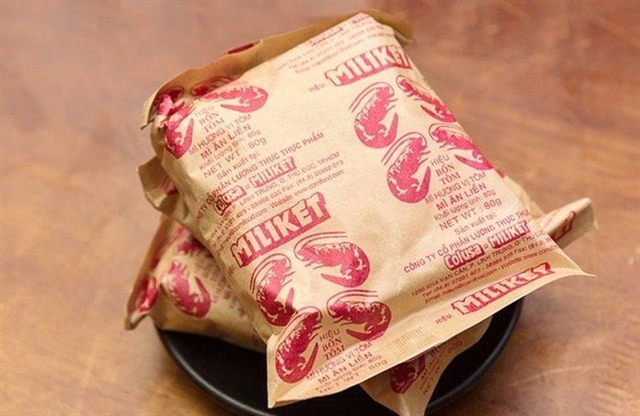 As Vietnamese manufacturers decided to add the shrimp flavour instead of the original chicken flavour from Japan, the instant noodles were widely known as mỳ tôm (shrimp noodles) in Việt Nam — Photo courtesy of Miliket
That magical mỳ tôm was the reason a group of four to five children of my age tailed a “big sister” in the neighbourhood as she was given a pack of instant noodles as a snack after school. I can still remember the taste of her dried noodles block, which was broken into pieces to share. Even the seasoning packet tasted so good.
Due to their convenience, affordable price and popularity, instant noodles have become a relief and charity food in Việt Nam and the entire world. Over time, instant noodles have changed and improved significantly. From just noodles at the beginning, Vietnamese manufacturers have also developed the instant version of Vietnamese bún (rice vermicelli), miến (vermicelli), cháo (porridge) and phở (rice noodles). From the paper package, there are now cups of noodles or even self-cooked containers. From just one flavor to a variety of hundreds of flavours. From just the image of a shrimp with a note “for demonstration purposes”, now customers can enjoy even instant noodles with full toppings.
The noodles have been associated with the lives of not just Vietnamese people. Despite debate and scientific research on the harm of instant noodles to health and diet, the dish is still widely consumed across the world and remains very popular in Asia generally. The latest estimated indexes from the World Instant Noodles Association (WINA), which unites companies and organisations related to ready-to-eat and ready-to-cook food all over the world, show that 10 out of the top 15 countries with the highest demand for Instant Noodles in 2021 are from Asia. Of those, Việt Nam ranks third with 8.56 billion servings per year, just after (of course) China with 43.99 billion servings and (unsurprisingly) Indonesia with 13.27 billion servings.
Việt Nam is in the top place in terms of servings per person in 2021, followed by South Korea and Nepal, with an average of 87 servings eaten per person annually, which means, a Vietnamese person eats one serving of instant noodles every four days on average.
And by typing this, I have realised that it is not just that I am craving Vietnamese instant noodles. It is indeed also the feeling of nostalgia. VNS