
Public Spending
Public finances - money in, money out
One of the most important roles of any government is to manage the public finances. This involves making decisions on raising and spending public money.
The public finances can be broken down and understood in different ways. But there are always two essential components: money that is raised and money that is spent.
- Public revenue: This is money the government raises, mainly from taxes, like income tax and levies on goods and services. There are also other sources, for example surplus income from commercial semi-state companies.
- Public spending: This is also referred to as public expenditure. It is the taxpayers’ money (plus State borrowings) that the government spends. Public spending is limited by the amount of revenue available to the government and the size of the public debt.
Both public revenue and public expenditure are often discussed in cash terms. But they can both also be expressed as a percentage of the overall economy, or Gross Domestic Product (GDP) .
How governments raise revenue

There are two main categories of taxes: direct taxes and indirect taxes.
Direct taxes These include income tax and the Universal Social Charge (USC) which is payable on gross income, i.e. before income tax is deducted.
Pay Related Social Insurance (PRSI or Social Insurance) is often counted alongside income tax as part of the total taxes on paid work.
However, it is not technically a tax, and is designed more as an insurance premium. It does not go into the government’s central tax fund, but instead is paid into the Social Insurance Fund.
This money is then used to pay certain benefits like state pensions or illness benefits. This fund is sometimes referred to as part of the 'social safety net'.
Indirect taxes These include 'consumption taxes,' based on things we buy as consumers, such as Value Added Tax (VAT) which is levied on goods and services.
Excise duties, which are paid on goods like alcohol, cigarettes and fuel, are another form of consumption tax.
Other indirect taxes are: taxes on property (the Local Property Tax); taxes on capital (like inheritance tax or gift tax); and corporation tax (a levy on companies’ profits).
Income tax and VAT are generally the two main sources of public revenue raised by the Irish government each year. For example, in 2014 these two sources accounted for almost two thirds of all tax revenue,according to figures from the Revenue Commissioners.
Collapse of tax revenue post financial crisis
After the financial crash of 2008, tax revenue in Ireland collapsed. This included reductions in:
- income tax as people lost their jobs
- taxes on sales and purchase of property as the property market collapsed
- corporation tax as companies lost profits
- VAT as people stopped consuming so much and sales of goods and services went down
At the same time, social welfare payments had to increase to meet the demand from growing numbers of people who had become unemployed. The result was that the amount needed for public spending exceeded the amount of public revenue raised.
Progressive and regressive taxes
Taxes can be progressive or regressive.
Progressive taxes are those that increase as a percentage of gross income, as incomes rise. Income tax is technically a progressive tax because the rate progresses upwards, with someone on a higher income paying some of their taxes at a higher rate meaning that they pay proportionately more.
Regressive taxes are those that take a greater proportion of income from low earners as opposed to high income earners.
For example, VAT is generally considered a regressive form of taxation. This is because the same amount must be paid by everyone, regardless of their income level. The result is that lower earners pay a higher percentage of their overall income in VAT than higher earners.
Government borrowing
Typically, it sells government bonds, in which it promises to pay back the face value of the bond plus interest by a certain date.
Since 2008, Ireland has also had to borrow substantial amounts of money from the European Central Bank, EU Commission and the International Monetary Fund. This was because the banking and economic crisis led to a huge expansion in the country’s national or sovereign debt.Some, but not all, of this debt was a direct result of the government’s move to ‘bail out’ privately owned banks.
How public money is spent
Every year, the single largest chunk of government spending goes to social protection, including disability and unemployment supports and pensions. The main purpose of these payments is to provide a safety net so that individuals and families do not fall below a minimum standard of living.
This also includes child benefit which is paid for every child regardless of the income of the parent(s) and is an important contribution to the support of children and the reduction of 'poverty traps'.
Funding for public services is the second largest category of public spending. These services include health, education, local government, defence and the salaries of civil and public servants, like government officials, nurses, doctors, teachers, social workers and gardai.
Investment in economic and social infrastructure to support private enterprise and economic activity and enhance the quality of life of all citizens is the third main category of public spending each year.
This would include funding to attract business investments, improve transport networks, develop agriculture and tourism, and protect consumers.
How €69.8 billion in public money was spent in 2012 (source: Eurostat, 2012)
The piechart below gives a breakdown of how the government spent almost €70 billion in public money in 2012. It shows that the ‘big three’ spending areas are social protection, health, and education.
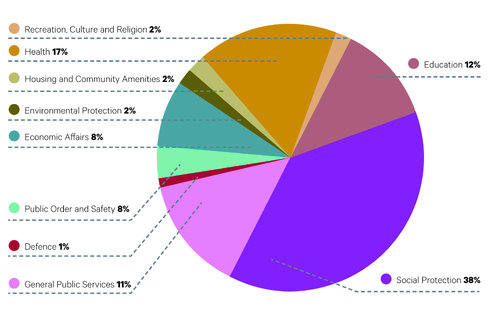
- €7,036 on health services
- €5,155 on education
- €780 on cultural and recreational activities
- €163 on fire protection services
The category labelled in the pie chart ‘general public services’ includes interest repayments on Ireland’s national debt.
Note about the pie chartWhile there are more up to date figures on government spending, the pie chart shows spending across the ten 'functions of government'. This is a standard UN classification that allows public spending in a country to be compared over time, and also to be compared with public spending in other countries.
Links between private sector and public sector
The private sector and the public sector are closely linked and mutually dependent.
The private sector relies on the quality of publically-funded infrastructure such as roads and internet broadband, as well as education and health services, training, public transport and other services. All of these create an environment in which private business can thrive.
The public sector purchases goods and services from the private and not-for-profit sectors.
The government also supports employers and the self-employed in a variety of ways. For example:
- State assistance is provided to businesses from Enterprise Ireland, the Industrial Development Authority and County Enterprise Boards.
- The farming and fishing industries also receive direct government help via subsidised diesel fuel.
- Farmers and fishermen receive direct payments from the European Union's Common Agricultural Policy and Common Fisheries Policy. These are paid for by the taxpayers of all EU Member States, including Ireland, by the transfer of a proportion of national VAT receipts to the European Union.
Link nội dung: https://chodichvu.vn/a-public-spending-programme-a50070.html